OTOW Press Association
Basic Writing Guidelines
STYLE
In the fashion world, "style" is your public appearance. Style is based on the social environment, personal taste, colors, fabrics and a personal opinion. In other words, there is an endless supply of style options and combinations. That's why picking out a personal style can be fun.
The newspaper business has style, too, but it is very different from picking out a shirt, pants and shoes. When creating a newspaper, style refers to the way writers compile their stories. Whether the newspaper has 10 reporters, 80 reporters or 500 reporters, everyone has to use the same style guidelines so readers can comfortably browse from article to article. If 500 writers used their own personal styles, readers would constantly have to adjust from author to author and from story to story. Unfortunately, individual style is not welcome at a newspaper. One of the most important aspects in making a newspaper fun to read is to make sure the reader feels comfortable. Everyone's style must be the same, which may sound like a challenge, but by providing guidelines, this achievement is very possible.
Back in the 1970s, the Associated Press created a set of writing guidelines which are used by almost every newspaper in the country. This means, in theory, that someone writing for the New York Times is writing using the same style as someone writing for the Chicago Tribune. The benefit, of course, is that one article submitted to the Associated Press can be used in any newspaper across the country. Editors don't have to worry if a specific story meets their style guidelines because all stories are written with the same guidelines. Sure, there might be minor difference from newspaper to newspaper, but in general the style is the same. We call this the AP Style and we use it in our community newspaper.
Here are some AP Style basics:
(1) Never abbreviate words on first reference, no matter how common the word. For example, always write out On Top of the World on first reference. You may use OTOW on remaining references. Why? You never want someone to stop in mid-sentence to think, "what does that abbreviation mean?"
(2) Never use name tags such as Mr., Mrs. or Miss.
(3) On first reference, never use someone's first name without their last name. You may know who Joe is, but someone in another building might not know Joe. On second reference, if the same name appears later in the same article, you are permitted by this newspaper to use just the person's first name. For major, national newspapers, this style is completely different. Major newspapers will only use last names on second reference. However, the Press Association requested first names and so we all use first names.
(4) Any number from one to nine is always written out. Any number from 10 to a zillion is written in numerical fashion. There are exceptions. A person's age is always a number. A date during the month is always a number. Addresses are always numbers. Golf clubs are always numbers. First words in headlines are always written out. One million is written out instead of 1,000,000, but 1,356,879 is written in numerical form. If you have a question what to use, ask.
(5) Days of the week are always written out when used in a sentence, Monday, Tuesday, Wednesday, etc.
(6) Months are never abbreviated when used alone in a sentence. Months, followed by numerical days, are always abbreviated, except for March, April, May, June and July. Months, followed by a year, are never abbreviated. Here are some examples: His birthday is in March. His birthday is March 1. Her birthday is Jan. 1. In March 2013 he will graduate from college.
(7) When reporting time, always use a.m. or p.m. (lowercase with periods). There are no exceptions. Never use the word "o'clock." Never follow p.m. with the word "afternoon." Never follow a.m. with the word "morning." It's just repeating information. Instead of writing 12 p.m. use the word "noon." Instead of writing 12 a.m. use the word "midnight." Never use :00 for a time exactly on the hour. Write 1 p.m., not 1:00 p.m.
(8) Quotation marks always go outside end punctuation. For example: ." or ," or ?"
(9) A person's work title is only uppercase if it appears before a person's name and must be the entire work title, not a portion. For example, Press Association President Yvonne Courtney is correct. Yvonne Courtney, Press Association President, is incorrect. Also incorrect is President Yvonne Courtney. Yvonne Courtney, Press Association president, is correct.
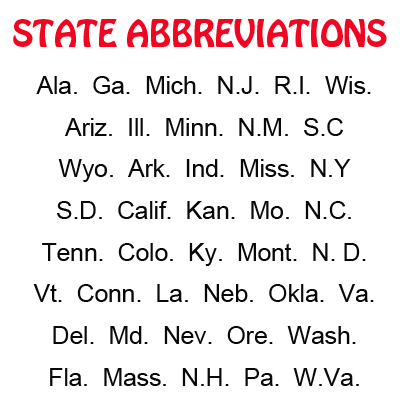
(10) States are always written out in a story when not preceeded by a city. States are abbreviated when they are preceeded by a city. States that are never abbreviated are Alaska, Hawaii, Idaho, Iowa, Maine, Ohio, Texas and Utah. In sentences, uncommon cities are always followed by their state. Well-known (obvious) cities are not followed by a state. For example, Los Angeles, Atlanta, Miami and Dallas are some cities which don't need a state listed after them. On the other hand, Jamestown, Union City, Johnsonville and Cedarville all need to be followed by their appropriate state, in abbrevidation form, if the state is abbreviated.
(11) Never replace words in a sentence with symbols. For examples, & does not replace "and" and + does not replace "and."
(12) Money amounts must use a $ symbol in the beginning. Never use .00 to represent an even dollar amount, such as $5.00. Write it simply as $5. Never write $0.75 to represent cents. Always write it "75 cents." Any simple, even dollar amount over $9,999 should be written with a number and a word. For example, $1 million or $3 million or $7 billion, but $6,750,000 has to be written out completely in numerical form.
(13) When using a street name alone in a story, always write out the word Street, Avenue or Boulevard, etc. If you are providing an actual address, the St. and Ave. are abbreviated. Technically, the words Boulevard, Court, Road and others are never abbreviated. Also, First Avenue is "First Avenue" not "1st Avenue."
(14) Never use the current year in a story. You should use a prior or future year if giving a date in the past or future.
(17) When referring to the finishing order of an athletic event, always write out first place, second place and third place, etc. Terms such as 1st place, 2nd place or 3rd place are not accepted.
(18) Never use a half parenthesis. Use of parenthesis must include both sides (). If you used a semicolon in a story, there is a 99 percent chance you used it incorrectly or didn't need it at all. A general rule - don't use semicolons. On the same note, the word "that" is the most unnecessary, overused word in the English language. If you wrote it, go back and make sure you needed it.
(19) Use the word "percentage" instead of the symbol %. Use the words "feet," "inches" and "yards" in measurements. Do not use " for inches or ' for feet. Use the word "degree" when referring to temperature.
Our World
Stories should not be more than 300 words. In some cases, such as feature stories, permission is given to exceed 300 words. Why 300? The main reason is we have a lot of stories to fit in one edition of the newspaper. If everyone wrote more than 300 words, we'd never get everything in. Second, just the sight of a story can deter someone from reading it. It's a fact, people prefer to read short stories compared to long stories. A good writer can decide between good information and unnecessary information and give the reader information they are looking for in 300 words or less. Stories which are bloated usually stray from what's important and can contain information which is not of value. Too much information is sometime hard to digest and harder to remember.
(1) Always refer to the recreation building on the east side as the East Activity Center, and the recreation building on the west side as the West Activity Center. Currently there are over 15 different names for these two buildings. In this newspaper we only use East Activity Center and West Activity Center. There are no exceptions.
(2) You must write stories with factual information. No guessing. No gossip. No rumors. If you are writing a story about someone, make sure they know about it and get their permission. Don't surprise anyone. If they don't want a story written about them, then don't do it.
(3) Do not use the names of children or grandchildren. Our newspaper may be read Online and there have been reported cases where bad people have tried to use the names of children and grandchildren to trick parents and grandparents out of large sums of money. You can mention someone has children or grandchildren, just don't use names.
(4) In our little world, do not write about the weather. No one wants to read 10-40 weather stories in one newspaper.
(5) You may not write editorials or viewpoints. You may not write negative stories about another person, club or building. You may not write about someone who has died. No negative news. No bad news. If it's not good, don't write about it.
(6) Do not write stories about people who are going on vacation or are currently on vacation. Wait for them to come home. We never want to tip off burglars that someone may not be home.
(7) Don't turn your story into an advertisement. You can state your club or building went to a restaurant for a party, but don't say whether the food was good or bad - that's advertising.
(8) Keep religion out of your stories. Keep politics out of your stories. Why? You will never get yourself in trouble if you leave it out.
(9) A person is a "who" not a "that." For example, this is wrong: The Old World Spanish building president, that returned home last month, was quick to schedule the first winter meeting. This is correct: The Old World Spanish building president, who returned home last month, was quick to schedule the first winter meeting.
(10) Don't create your own grammar rules. Use the same rules you learned in elementary school. Only uppercase words that are supposed to be uppercase. Don't get cute. The word "free" is only uppercase when starting a sentence.
(11) When writing, use short sentences and brief paragraphs. Information is easier to digest when there aren't so many words. Keep your sentences to two to three per paragraphs. Use a clever lead to your story. Entice a reader to continue reader. Don't tell the whole story is just the opening paragraph.
(1) Always refer to the recreation building on the east side as the East Activity Center, and the recreation building on the west side as the West Activity Center. Currently there are over 15 different names for these two buildings. In this newspaper we only use East Activity Center and West Activity Center. There are no exceptions.
(2) You must write stories with factual information. No guessing. No gossip. No rumors. If you are writing a story about someone, make sure they know about it and get their permission. Don't surprise anyone. If they don't want a story written about them, then don't do it.
(3) Do not use the names of children or grandchildren. Our newspaper may be read Online and there have been reported cases where bad people have tried to use the names of children and grandchildren to trick parents and grandparents out of large sums of money. You can mention someone has children or grandchildren, just don't use names.
(4) In our little world, do not write about the weather. No one wants to read 10-40 weather stories in one newspaper.
(5) You may not write editorials or viewpoints. You may not write negative stories about another person, club or building. You may not write about someone who has died. No negative news. No bad news. If it's not good, don't write about it.
(6) Do not write stories about people who are going on vacation or are currently on vacation. Wait for them to come home. We never want to tip off burglars that someone may not be home.
(7) Don't turn your story into an advertisement. You can state your club or building went to a restaurant for a party, but don't say whether the food was good or bad - that's advertising.
(8) Keep religion out of your stories. Keep politics out of your stories. Why? You will never get yourself in trouble if you leave it out.
(9) A person is a "who" not a "that." For example, this is wrong: The Old World Spanish building president, that returned home last month, was quick to schedule the first winter meeting. This is correct: The Old World Spanish building president, who returned home last month, was quick to schedule the first winter meeting.
(10) Don't create your own grammar rules. Use the same rules you learned in elementary school. Only uppercase words that are supposed to be uppercase. Don't get cute. The word "free" is only uppercase when starting a sentence.
(11) When writing, use short sentences and brief paragraphs. Information is easier to digest when there aren't so many words. Keep your sentences to two to three per paragraphs. Use a clever lead to your story. Entice a reader to continue reader. Don't tell the whole story is just the opening paragraph.